
Documents Required to Buy a Plot in Bangalore — Complete 2026 Checklist
Why Document Due Diligence is Non-Negotiable for Bangalore Plot Buyers
Buying a residential plot in and around Bengaluru represents one of the most rewarding wealth-creation decisions an Indian family or NRI investor can make. Unlike constructed apartments—where buyers share fractional undivided land shares (UDS)—purchasing a plot grants you absolute, freehold ownership of physical earth.
However, land transactions in Karnataka operate under a complex web of town planning acts, revenue codes, conversion laws, and digital registry frameworks. Handing over token advance money based merely on glossy marketing brochures or verbal assurances from real estate brokers is the primary reason buyers find themselves entangled in protracted legal disputes.
To protect your hard-earned capital, this guide presents a comprehensive, practical checklist of the documents required to buy a plot in Bangalore in 2026. Every document listed here must be scrutinized by your independent property advocate before executing an agreement of sale.
1. Title Flow & Ownership Proof (The Mother Deed)
The Mother Deed (also referred to as parent title documents) traces the legal origin and historical chain of ownership of the property for the past 30 to 40 years:
- Continuous Lineage: Documents how the land was acquired across successive owners—whether through registered sale deeds, inheritance partitions, gift deeds, or government grants.
- Zero Break in Title: There must be no unexplained gaps in the ownership chain. Every historical transfer must correspond to a registered deed registered with the jurisdictional Sub-Registrar.
- Family Partition Deeds: If the land originated from ancestral Hindu Undivided Family (HUF) property, ensure all legal heirs (including daughters with statutory coparcenary rights under the Hindu Succession Amendment Act) consented and signed release or partition deeds.
2. Land Conversion Order (DC Residential Conversion)
In Karnataka, all land is legally classified as agricultural by default. Under Section 95 of the Karnataka Land Revenue Act, 1964, farmland cannot legally be divided into residential plots or developed with houses without an official DC Conversion Certificate:
- Issued by the Deputy Commissioner (DC) of the respective revenue district (Bengaluru Urban, Bengaluru Rural, or Kolar).
- Certifies that statutory conversion penalties have been paid and the land use is formally altered from agricultural to "Residential".
- Crucial Check: Always confirm that the conversion is explicitly for *residential* purposes, not commercial or industrial.
3. Statutory Layout Sanction & Approved Drawing Plan
Purchasing an individual plot carved out of farmland without town planning sanction is illegal in Karnataka. The layout must be approved by the designated planning authority:
- DTCP (Directorate of Town and Country Planning): The statutory authority for layouts outside BBMP/BDA limits across high-growth corridors like Narasapura, Vemgal, and Doddaballapura. Read our comprehensive guide to [DTCP approval explained](/blog/dtcp-approval-explained/) for detailed norms.
- BDA / BMRDA / BIAAPA: Applicable to specific metropolitan planning boundaries.
- Relinquishment Deed: The developer must produce a registered relinquishment deed showing that internal roads, civic amenity (CA) spaces, and community parks have been formally transferred to local civic bodies, preventing future encroachment.
4. Encumbrance Certificate (EC Form 15)
An Encumbrance Certificate (EC) is issued by the Sub-Registrar confirming whether any registered transactions, mortgages, court attachments, or liabilities exist against the property:
- Form 15 vs Form 16: Always demand Form 15. Form 15 lists all registered transactions chronologically. If a property has zero liabilities, Form 15 will explicitly state "Nil Encumbrance". (Form 16 is issued only when no registered transactions exist during the specified search period).
- Duration: The EC must span a continuous period of at least 30 years up to the present week of your transaction.
5. Khata Documents: E-Khata Form 9 & Form 11A
A Khata represents the property's administrative tax assessment account. In 2026, manual paper khatas are obsolete and will be rejected by registration authorities:
- Urban Properties (BBMP): Must carry a digital A-Khata certificate on the e-Aasthi platform. Learn why B-Khata properties face severe loan and building license bans in our guide on [A-Khata vs B-Khata in Karnataka](/blog/a-khata-vs-b-khata-karnataka/).
- Rural & Gram Panchayat Properties: Outside BBMP limits, plots must carry an authentic electronic Form 9 (layout boundary certificate) and Form 11A (non-agricultural property tax register extract) generated via the government's e-Swathu database.
- PID Number: The E-Khata must contain a unique 18-digit Property Identification Number and a scannable QR code. Read our dedicated guide on [E-Khata meaning and verification](/blog/e-khata-explained-karnataka/) to verify records online.
6. RTC / Pahani & Revenue Sketches (Village Survey Records)
To confirm physical land boundaries, inspect the official land revenue survey records:
- RTC (Record of Rights, Tenancy and Crops / Pahani): Issued under the government's Bhoomi portal, documenting survey numbers, total acreage, soil classification, and revenue tax liability.
- Akarband & Tippani: Official survey department sketches depicting the precise boundary dimensions, angles, and cart-track rights of the original survey number.
- Mutation Extract (Form 21): Certifies the administrative transfer of revenue titles following previous sales or inheritances.
7. Tax Paid Receipts (Latest Up-to-Date Year)
Ensure the seller or developer provides the latest property tax paid receipt issued by the BBMP, City Municipal Council, or Gram Panchayat. Outstanding property taxes become the legal liability of the new purchaser upon registration.
8. Summary Checklist Table for Bangalore Plot Buyers
Print this quick reference checklist before meeting any land seller:
| Legal Document | Issuing Authority | Primary Purpose | Verification Method | | :--- | :--- | :--- | :--- | | Mother Deed (30-40 Years) | Sub-Registrar Office | Proves unbroken historical ownership chain | Legal advocate scrutiny | | DC Conversion Order | Deputy Commissioner | Alters farmland to non-agricultural residential use | District Revenue Office records | | Layout Sanction Blueprint | DTCP / BDA / BIAAPA | Authorizes road widths, parks, and plot demarcation | Planning authority website | | Encumbrance Certificate (Form 15) | Sub-Registrar Office | Certifies zero mortgages, liens, or court attachments | Kaveri 2.0 online EC search | | E-Khata (Form 9 & 11A) | Gram Panchayat / RDPR | Tax assessment and digital registration clearance | e-Swathu portal (e-swathu.kar.nic.in) | | Latest Property Tax Receipts | Local Panchayat / BBMP | Confirms property tax dues are paid up to date | Municipal tax portal | | RTC / Pahani Extract | Revenue Department | Village survey boundary and ownership record | Bhoomi portal (bhoomi.karnataka.gov.in) |
Navigating the Registration Phase: Kaveri 2.0
Once your legal advocate completes document scrutiny, you will enter the formal registration phase. In Karnataka, all land registrations now operate through the Kaveri 2.0 digital portal:
1. Execute a formal Agreement of Sale outlining payment milestones and handover timelines. 2. Upload draft sale deed, identity credentials (PAN & Aadhaar), and E-Khata PID numbers to Kaveri 2.0. 3. Pay stamp duty (typically 5% + cess) and registration fees (2%) online. 4. Complete biometric verification and photo capture at your scheduled 15-minute Sub-Registrar appointment.
Read our complete walkthrough on the [step-by-step plot buying and registration process in Karnataka](/blog/plot-buying-process-karnataka/) for appointment-day guidelines.
Niketh Estates Commitment: 100% Document Transparency
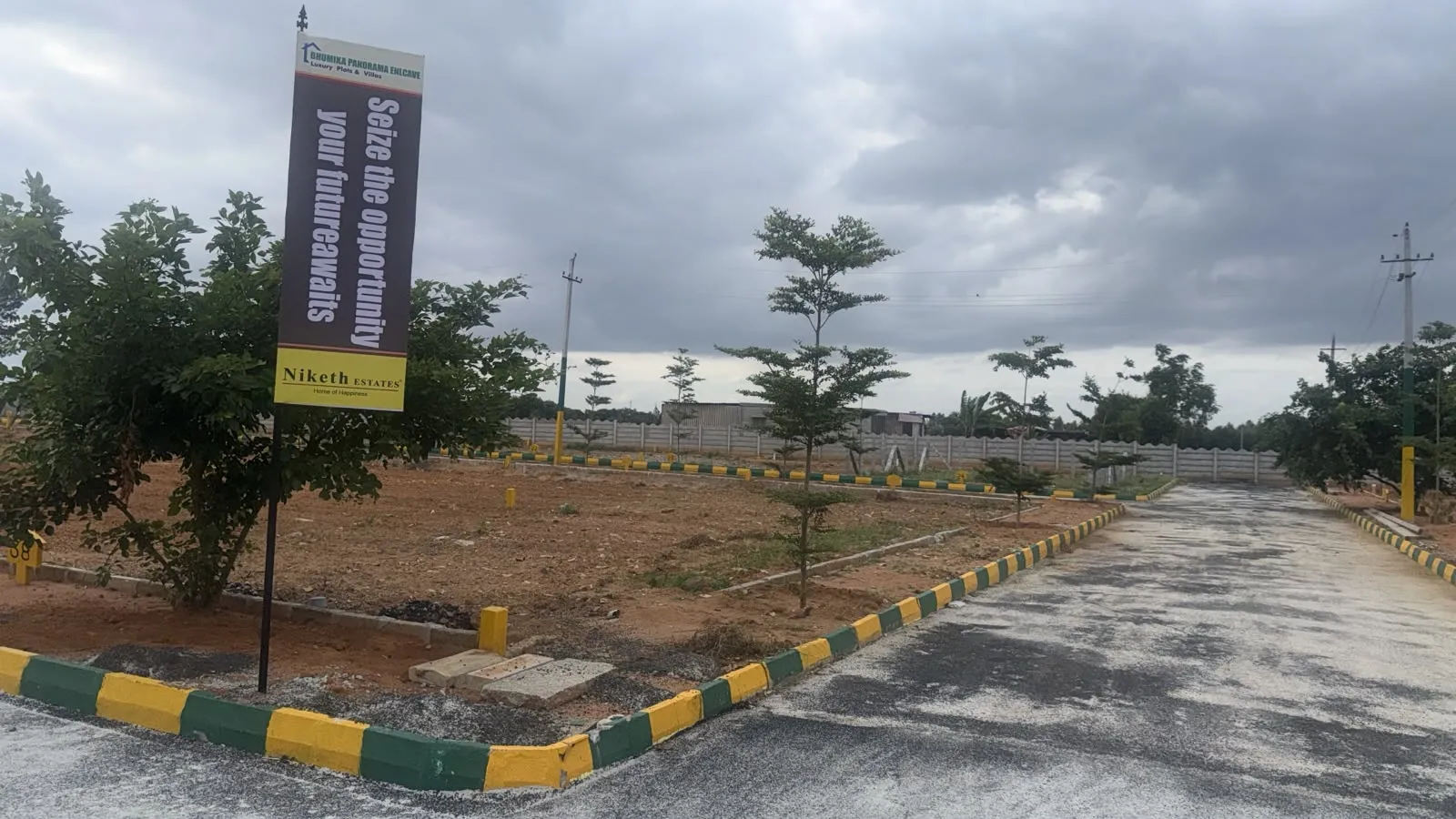
At Niketh Estates, every project we develop—including [Bhumika Panorama Enclave](/projects/bhumika-panorama-enclave/) (Narasapura), [Avinya Enclave](/projects/avinya-enclave/) (Vemgal), and [Gathyri Enclave](/projects/gathyri-enclave/) (Rajanukunte)—carries an exhaustive, pre-verified legal dossier. We welcome independent legal scrutiny and provide complete certified copies of all conversion decrees, layout sanctions, and E-Khata documentation to all prospective buyers.
Common Questions & Practical Answers
The Mother Deed (chain of title deeds for the past 30 to 40 years) along with a nil-encumbrance certificate (EC Form 15) is the single most critical legal document. It proves unencumbered, continuous ownership lineage without family disputes or mortgage liabilities.
No. In Karnataka, agricultural land cannot legally be partitioned or utilized for residential housing without an official conversion order issued by the Deputy Commissioner (DC Conversion) under Section 95 of the Karnataka Land Revenue Act. Purchasing non-converted revenue land carries severe risks of municipal demolition, lack of building licenses, and loan denial.
An Encumbrance Certificate (EC) verifies whether a property has any registered financial or legal liabilities—such as active mortgages, court attachments, or prior sale agreements. In Bangalore, buyers must obtain an EC Form 15 covering a continuous period of at least 30 years up to the present date.
Under Karnataka's Kaveri 2.0 digital registration system, sub-registrars are legally mandated to execute an automated API handshake with the government's e-Swathu (rural) or e-Aasthi (urban) digital databases. Manual paper records are rejected by the registration software to prevent forged titles and double-selling.
Banks require: 1) Approved layout sanction blueprint (DTCP, BDA, or BIAAPA); 2) DC Conversion order; 3) 30-year Encumbrance Certificate; 4) Registered Mother Deed flow; 5) Latest tax-paid receipts; 6) Form 9 and Form 11A E-Khata; 7) Draft Agreement of Sale; and 8) Buyer financial credentials (salary slips, ITR, bank statements).
Recommended Opportunities & Locations
Bhumika Panorama Enclave
DTCP approved villa plots from ₹3,499/sq.ft
Invest in Narasapura
40-45 mins (45 km via STRR) • Industrial Hub
Speak to Our Legal Advisor
Get free legal scrutiny support and DTCP guidance for your plot purchase.